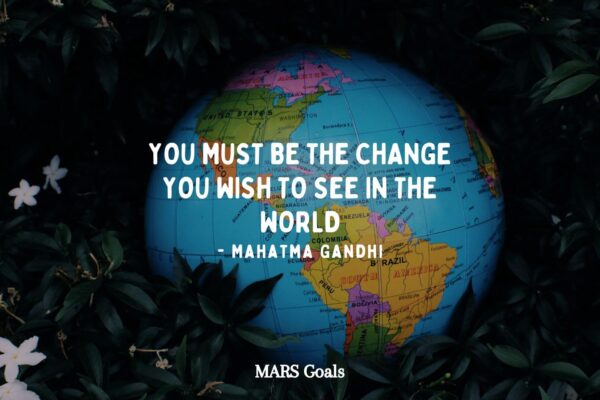
“Be the change you wish to see in the world” is probably the most shared quote credited to Mahatma Gandhi, and there is no reliable evidence he ever said it in those words. You have seen it on posters, coffee mugs, classroom walls and Instagram captions, almost always with his name underneath.
That does not make the idea worthless. The thought behind it appears in something Gandhi wrote in 1913, and it holds up well. In this post we look at what the quote means, where it really came from, and how to use it without spreading a false attribution.
Explore more: Mahatma Gandhi Quotes
The short answer
Meaning: Real change starts with your own behavior. Instead of waiting for other people, institutions or circumstances to improve, you start living the way you hope the world will be, and your example does the persuading.
Origin: The exact wording cannot be traced to Gandhi. Quote Investigator, a site that researches where quotes come from, found no reliable documentary evidence for it. Close versions appear in the 1970s, and the Gandhi label became common only in the late 1980s. The nearest thing he actually wrote dates to 1913.
Where the quote really comes from
| When | What happened |
| 9 August 1913 | Gandhi writes in his newspaper Indian Opinion that if we could change ourselves, the world’s tendencies would change too. The idea is close; the wording is not. |
| Early 1970s | Close versions of the phrase appear in print, linked to Arleen Lorrance, a Brooklyn teacher, and her “Love Project”. |
| 1987 | The earliest known attribution of the saying to Gandhi, according to Quote Investigator. |
| 1989 | The Los Angeles Times and a health and fitness book both print the line with Gandhi’s name on it. |
| Today | Posters, memes and speeches repeat it as his own words. |
Quote Investigator lists several possible originators, so the true author is still uncertain. What is clear is how it spread: once a few books and newspapers printed it with his name, everyone else copied them. That is how most misattributed quotes travel.
What Gandhi actually wrote?
In the 9 August 1913 issue of Indian Opinion, in an article on health, Gandhi argued that we mirror the world: the tendencies we see outside us are also found within us. If we could change ourselves, he said, the tendencies in the world would change as well. Then he added the line that is closest to the modern slogan: “We need not wait to see what others do.”
The two versions differ in tone. Gandhi’s passage is an observation about how our inner life and the outer world are linked. The slogan is a command, short enough for a poster. Both say the same thing at heart: stop waiting for others and start with yourself.
The safest way to credit the popular wording is “often attributed to Mahatma Gandhi”, or “inspired by Gandhi” if you want to link it to his 1913 writing.
What the quote means?
The quote packs four ideas into ten words:
- Start with yourself. You cannot control other people, but you fully control your own habits, words and choices.
- Show, don’t lecture. People are more likely to copy what they see you do than follow what they hear you say.
- Don’t wait for permission. Waiting for a leader, a law or a better moment is the most common reason good ideas never begin.
- Be, don’t just wish. The verb is “be”. Wanting a kinder, more honest or cleaner world only counts once your own daily behavior matches it.
How to apply it in daily life?
Pick the change you wish for, then ask what the smallest version of it looks like in your own day:
- A kinder workplace: thank people by name, give credit in public, and reply to messages politely even when you are busy.
- A cleaner neighborhood: separate your waste at home and pick up litter you pass, without waiting for a cleanup drive.
- A calmer home: pause for ten seconds before answering when you are angry.
- A reading habit in your family: let your children see you with a book instead of a phone.
- A more honest internet: check a quote or news item before you share it. Fittingly, this very quote is a good one to check.
Try this: choose one change and practice it every day for 30 days. A small action repeated daily changes more than a big one you do once.
Common misunderstandings
- “You alone must fix the world.” The quote is a starting point, not a full plan. Laws, institutions and group effort matter too. Gandhi himself led mass movements, not just personal habits.
- “So you should not criticize or demand change from others.” You still can. The quote only says your own conduct should not wait on theirs.
- “You must be perfect first.” Being the change means making honest, steady effort, not being flawless.
- “Gandhi said it, so it is his philosophy word for word.” As shown above, the wording is modern. Link it to his 1913 idea, not to a speech he never gave.
Final thoughts
The words may not be Gandhi’s, but the message is worth keeping: the change you want in the world begins with what you do today. Use the quote, credit it honestly, and then act on it. Looking for more? Browse our collection of Gandhi quotes and our quotes on change and motivation.